- Local Eyes NWA
- Posts
- Climate change is at your fingertips
Climate change is at your fingertips
Simple physical processes are behind more erratic, more extreme weather in the Ozarks and around the world.

Dan Holtmeyer
April 28, 2025
Believe it or not, one of the most powerful and important forces in the world is something you’ve probably experienced firsthand thousands of times.
Think back to the end of a long, hot summer day, perhaps when you took a walk around the neighborhood or ran around a playground as a kid. Imagine holding your hand a few inches off of the blacktop or away from your school’s brick wall, feeling the dull, constant heat radiating toward your fingers.
We understand intuitively what’s happening: The hot surface was out in the sun all day long, then the warmth lingered for a while even after the sun went down. And in fact these everyday switches from one thing to another — from visible sunlight to invisible heat, from heating up to cooling down — are the essence of climate change, the gradual warming, intensifying and shifting weather patterns that are causing problems all over the planet, including right here in Arkansas.
Let’s start with the switch from visible light to invisible heat. Whenever something absorbs energy, like the blacktop absorbing sunlight all day, it also must re-emit that energy soon after. The daily delivery of energy from the sun is sort of like a stock market, swapping constantly: It might be absorbed by clouds first, then traded to the ground, then traded to the ocean and the air, then back to the clouds or back to the surface, back and forth. As the energy changes hands, it’s also weakening, in a sense, from the kind of light we see with our eyes into the kind of light we feel with our skin: heat.
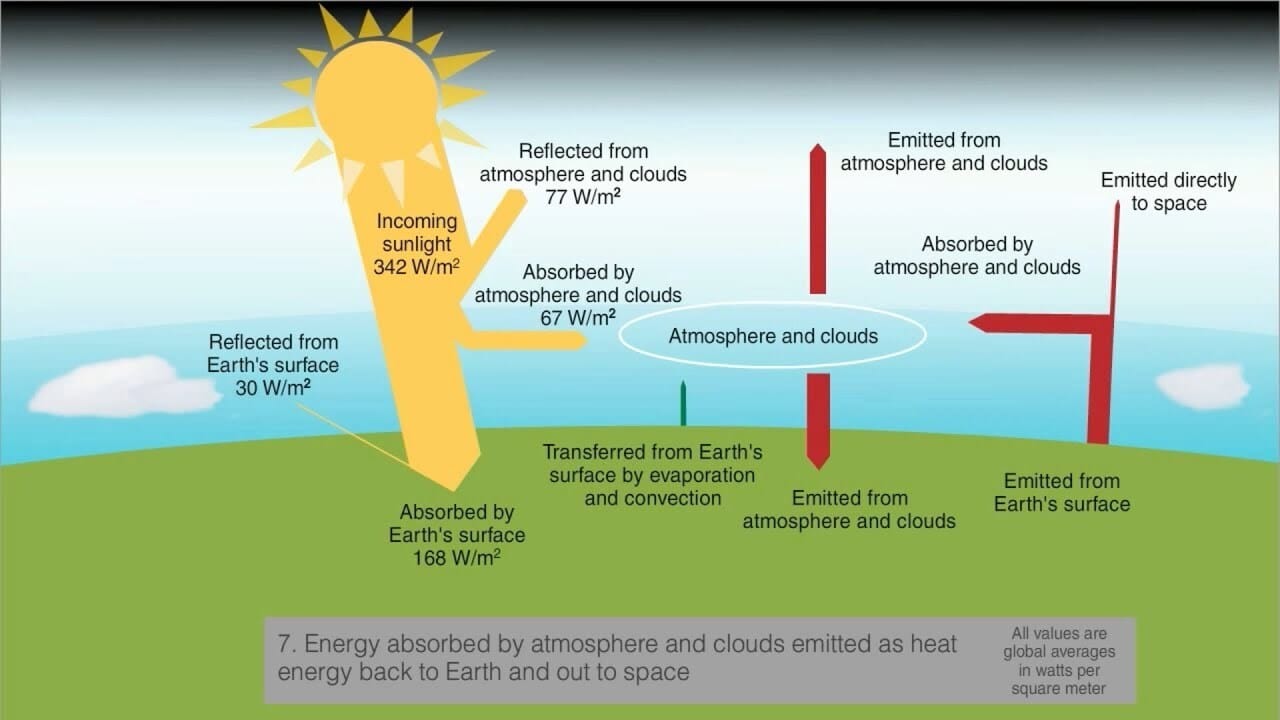
As you can see from the upward arrows in the diagram above, some of the energy goes right back where it came from, leaking back out into space. In fact, without Earth’s atmosphere, that’s where all of it would go, being lost almost as soon as it was gained. In that scenario, nightly temperatures would probably be more like they are on our airless moon, plunging to 200 degrees below zero.
Our atmosphere — particularly certain ingredients like water vapor and carbon dioxide — saves us from this extreme cooldown because it has a certain property: It lets visible light through fairly easily but is less passable for heat, like a bouncer standing outside the sunlight-only club. This is the greenhouse effect, and it’s something that physicists have understood for a very long time. The atmosphere is an imperfect barrier, however, with leaks and constant changes. So a balance arises, with temperatures falling at night and during the winter, when the sun’s delivery of energy shrinks or stops, but falling much less than they would otherwise. The cooldown is slower and more gradual.
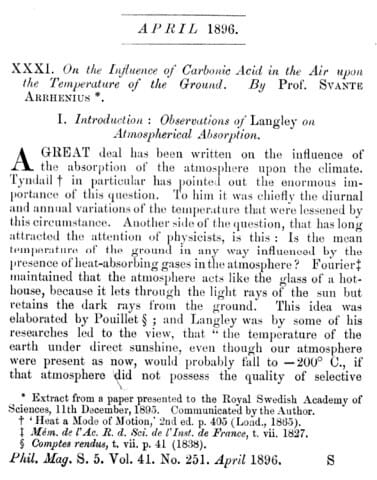
This is where fossil fuels come in. Coal and oil are conveniently usable forms of carbon that largely originated around 300 million years ago. During the Carboniferous Period, whole continents of trees and other plants were buried without decomposing after death, meaning all of the carbon they absorbed while alive stayed put. A huge amount of greenhouse gases were locked away, in other words, like a pharaoh in a tomb — until we humans came along and broke in.
Our coal plants and internal combustion engines are burning and releasing carbon that hasn’t seen daylight since before the dinosaurs — “a forest fire of the eons,” as Peter Brannen wrote in a wonderful 2019 article. As a result, we’ve pushed carbon dioxide to levels not seen in millions of years, supercharging the everyday greenhouse effect so that Earth is cooling down less, global average temperatures are rising, oceanic and atmospheric currents are changing, and we’re paying the price in our infrastructure, our food and our health.
The pharaoh’s curse is upon us, and it’s up to us to do something about it.